From Parking Lot to Public Plaza
The central gesture converts a supermarket parking lot into a grand public plaza—the district's social spine. This 1,600 sqm pedestrian realm stitches together disparate uses through active frontages, retail, food and beverage, and parklets. Rather than leftover space, open space becomes primary infrastructure that defines character.
Layered Program, Integrated Uses
The masterplan distributes 28,000 sqm across three zones. Medium-density residential blocks (17,000 sqm) address Cambridge's housing needs. A research institute (9,000 sqm) extends the city's innovation economy. The Commercial Zone preserves existing retail while adding mixed-use buildings. Student housing sits near institutions, while a 100-150 car parking structure consolidates vehicles away from pedestrians.
Connectivity and Frontage
Three strategic entry points from Memorial Drive, Magazine Street, and Pleasant Street create clear thresholds. Commercial functions concentrate along northern edges; residential blocks occupy the south near existing neighborhoods. All zones connect at ground level through retail, open space, and parks—creating continuous vitality.

Green Infrastructure as Community Thread
Landscape strategies extend Magazine Beach Park's character into the site, creating green connections between neighborhoods and riverfront recreation. The design preserves existing trees while introducing plantings that reinforce pedestrian routes and microclimatic comfort.
Density with Distinction
Building heights step down from the 15-story hotel toward residential zones, creating variety while maintaining human scale. Active ground floors ensure 24-hour vitality, transforming fragmented uses into a walkable district.
Memorial Drive Mixed-Use Masterplan demonstrates how infill development repairs urban fabric. By treating public space as primary structure, the design creates a model where diverse uses, economic accessibility, and civic vitality converge along Cambridge's riverfront.
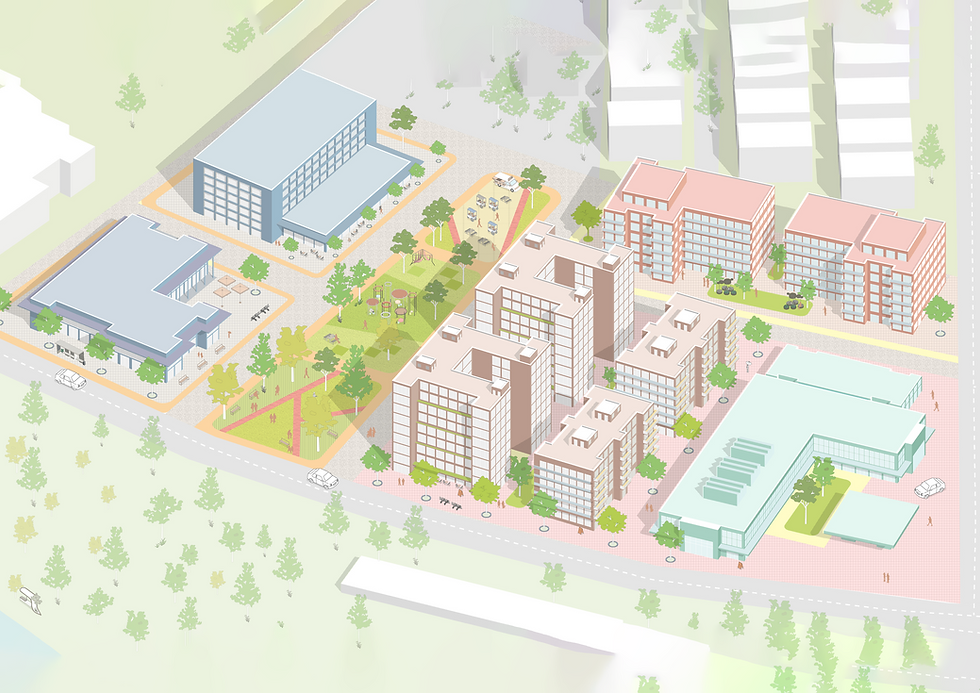
A sustainable settlement strategy that transforms underutilized commercial parcels along the Charles River into a vibrant mixed-use district, weaving together affordable housing, research facilities, and public space to serve both institutional and neighborhood needs.
Memorial Drive stretches along the Charles River connecting MIT and Harvard, lined with recreation facilities and student housing. Between campuses, however, the frontage has devolved into underutilized commercial uses—parking lots, isolated retail, and inactive frontages. This 5.5-acre site, anchored by a 15-story Marriott hotel and bordered by the Morse School, represents a critical opportunity to reconnect institutional districts with residential communities.
Four Strategic Imperatives
The design is structured around four strategies:
Connections (maximizing access and linking to residential areas),
Mix of Uses (integrating housing, research, and commerce),
Sense of Place (creating community hubs through public space), and
Green Pockets (transforming parking into landscape connections).
Transforming Cambridge's Forgotten Frontage into Connected Community
Category
Scope
Site Analysis, Urban Programming, Density Planning, Public Realm Design
Location
Memorial Drive, Cambridge, Massachusetts, USA
Size
5.5 acres (approx. 22,260 sqm)